Spacing out to Speak Up: Resistance, Protest, and Theatre in a Time of Political Crisis
Chapter 2 explores the historical trajectory of cultural resistance in Nepal, framing the 2005 royal state of emergency within a long legacy of autocratic rule. When King Gyanendra seized absolute power and suspended civil liberties in 2005, the public’s initial silence was not passivity, but a learned, strategic response rooted in decades of navigating state censorship.
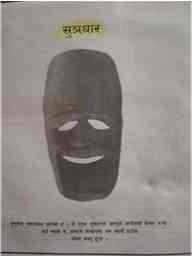
Editorial in Aarohan’s magazine “Nepathya” (February 2005)
The “Counterfeit Reality” of Public Space A central theme is the state’s historical manipulation of the public sphere. I draw on anthropologist Richard Burghart, who describes how the autocratic Panchayat regime (1960–1990), as a “counterfeit reality”, much like the 2005 Emergency. The state monopolized public space, permitting only expressions of national harmony and loyalty to the king. Because open political debate was banned, dissent was forced underground. To survive the strict “conditions of listening” dictated by the state, citizens and activists had to wear metaphorical masks, conforming outwardly in public while concealing their true political intentions.
Allegory, Trickery, and the Birth of Street Theatre To bypass censorship and the threat of imprisonment, theatre artists became masters of subversion. During the Rana and Panchayat eras, artists utilized religious festivals, allegorical language, and physical gestures to convey hidden messages to audiences while feigning compliance with authorities. For instance, words like “spring” symbolized democracy, and actors would submit “clean” scripts to censors but use contradictory, rebellious body language on stage. It was out of these highly oppressive conditions—combined with a lack of funds and formal stages, that modern Nepali street theatre (sadak natak) was born in the 1980s. Pioneers like Ashesh Malla (founder of the Sarwanam theatre group) moved to the streets out of “compulsion” to quickly reach the masses and evade police, transforming the street into a contested political arena.
Cultural Workers vs. Artistic Independence I also highlight the complex, often blurred boundaries between art and political activism. During the Panchayat era, banned political parties relied heavily on underground “cultural fronts.” Leftist cultural workers traveled through rural Nepal, disguising themselves as traditional folk musicians to evade police while spreading subversive messages through song and dance. However, a deep tension emerged between producing direct political propaganda and creating independent “real art.” While cultural workers embraced their roles as political spokepersons, many urban theatre artists and folk singers struggled to balance their democratic commitments with their desire for artistic integrity, resisting the pressure to become mere “sloganists.”
Strategic Silence and “Space-Brokering” Ultimately, through this chapter I tie this history back to the 2005 Emergency. Veteran artists relied on survival strategies honed during the Panchayat era. Their immediate lack of protest was a calculated tactic to safeguard private, creative sanctuaries, like the Gurukul theatre school, before exposing themselves to state violence. I argue that by mastering disguise, ambiguity, and tactical transgression, Nepali artists historically acted as “space-brokers,” bridging the gap between the repressed private sphere and the dominated public sphere to cautiously ignite political change.
To cite this book and read more: Rehearsing for Life. Theatre for Social Change in Nepal, Cambridge University Press (2018) available here.