The Ordinariness of the Special: Towards the Professionalization of Theatre Work
Overcoming Stigma and the Struggle for Respectability A dominant theme is the deep historical and social stigma attached to the performing arts. Traditionally associated with lower castes, itinerant performers, or the eroticized entertainment of nautanki and courtesans, acting was widely viewed as a financially ruinous and morally questionable pursuit. Modern theatre practitioners, though predominantly from high-caste (Bahun-Chhetri) and middle-class backgrounds, faced intense family opposition when choosing this career path. For female artists, the stigma was particularly severe, as acting violated traditional gender norms. Their participation required complex cultural negotiations; male directors often had to assure parents of the girls’ moral protection by ritually treating them as “sisters” (a bond cemented through the bhai tika festival).
This Chapter shifts the analytical gaze from the transformative, public moments of political and development theatre to the everyday, internal struggles of the artists themselves. It chronicles the organizational evolution of the Aarohan Theatre Group and its residential school, Gurukul, highlighting the artists’ quest to legitimize acting as a respectable, full-time profession in 2000s Nepal.
Legendary Nepali actor Prachanda Malla, a student of Balkrishna Sama’s, explains how to recite some lines from Sama’s “Mutuko Byatha” at Shilpi Theatre (part 2 available on the YouTube channel). He remembers how he became an actor in this chapter.
The Guru-Kul Model and Sacred Space To solve the chronic lack of training facilities and rehearsal spaces, Aarohan established Gurukul in 2002. The chapter explores the group’s “foundation myth” as a utopian leap of faith, driven by the charismatic vision of artistic director Sunil Pokharel. Gurukul operated as a modern adaptation of the traditional guru kul (house of the guru) system. Students lived together in a highly disciplined communal environment governed by traditional rules regarding gender interaction, hierarchy, and modesty. Furthermore, the theatre space itself was treated as sacred. Artists performed daily rituals, bowed to the stage, and honored the Hindu god of dance (Natyashwori), utilizing religious frameworks to elevate the moral and cultural status of their craft.


Daily life in Gurukul, festivals and celebrations, including my birthday.
The Paradox of Institutionalization The chapter also unpacks the paradoxes of organizational growth. Between 2005 and 2007, partnerships with international donors brought vital financial stability, regular salaries, and technical resources. However, this shifted Gurukul from an intimate, egalitarian artist commune into a structured, bureaucratic workplace. The crushing workload of producing continuous NGO-funded kachahari plays and proscenium dramas led to burnout. Ultimately, the utopian ideal of completely merging “theatre and life” proved unsustainable; artists eventually demanded private lives, regular days off, and physical separation from the workspace, re-establishing boundaries between their personal and professional identities.
Besides performing theatre for social change, during my fieldwork Aarohan Theatre artists were also trying to promote stage theatre. This clip is from a popular play “Fire in the Monastery”, written by Abhi Subedi and directed by Sunil Pokharel, Kathmandu, Nepal, 2012 (recording by the author and subsequent parts in the YouTube channel).
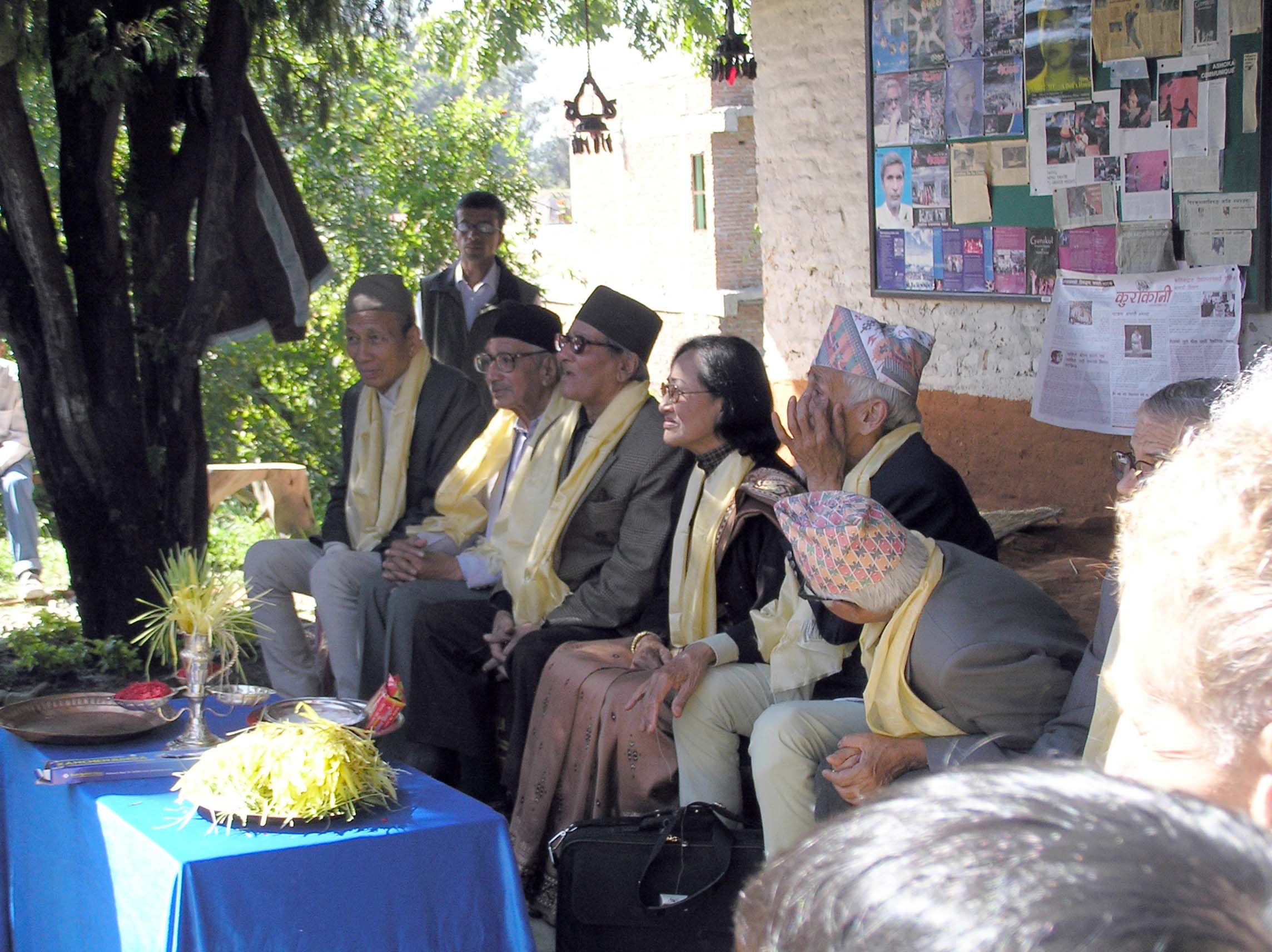
Senior theatre artists honoured on the day of Guru Purnima (2006)
Legacy and New Trajectories The chapter traces the lasting legacy of this professionalization. Although Gurukul was forced to close in 2012 due to soaring land rents, it successfully achieved its core mission. It “sanitized” the acting profession, proving it could be a viable, respected, and culturally significant career. The seeds planted by Aarohan blossomed as former students founded their own successful, independent theatre companies and venues such as Shilpi Theatre, Mandala Theatre, and Space Theatre, permanently transforming Kathmandu’s cultural landscape and establishing a thriving professional theatre industry in post-conflict Nepal.
To cite this book and read more: Rehearsing for Life. Theatre for Social Change in Nepal, Cambridge University Press (2018) available here.